This item is currently out of stock. We're waiting on parts or assembling units... thanks for your patience
This product ships from your country, so you don't
have to worry about import fees or tariffs.


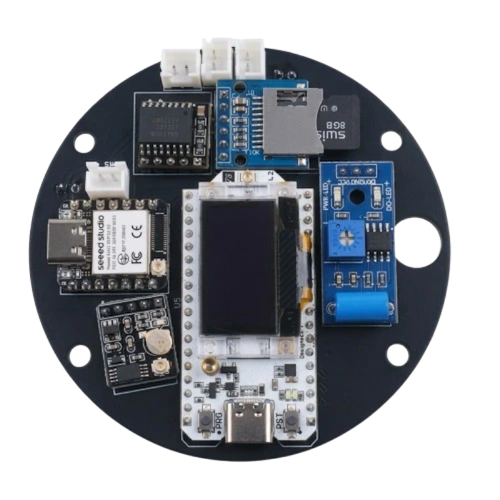
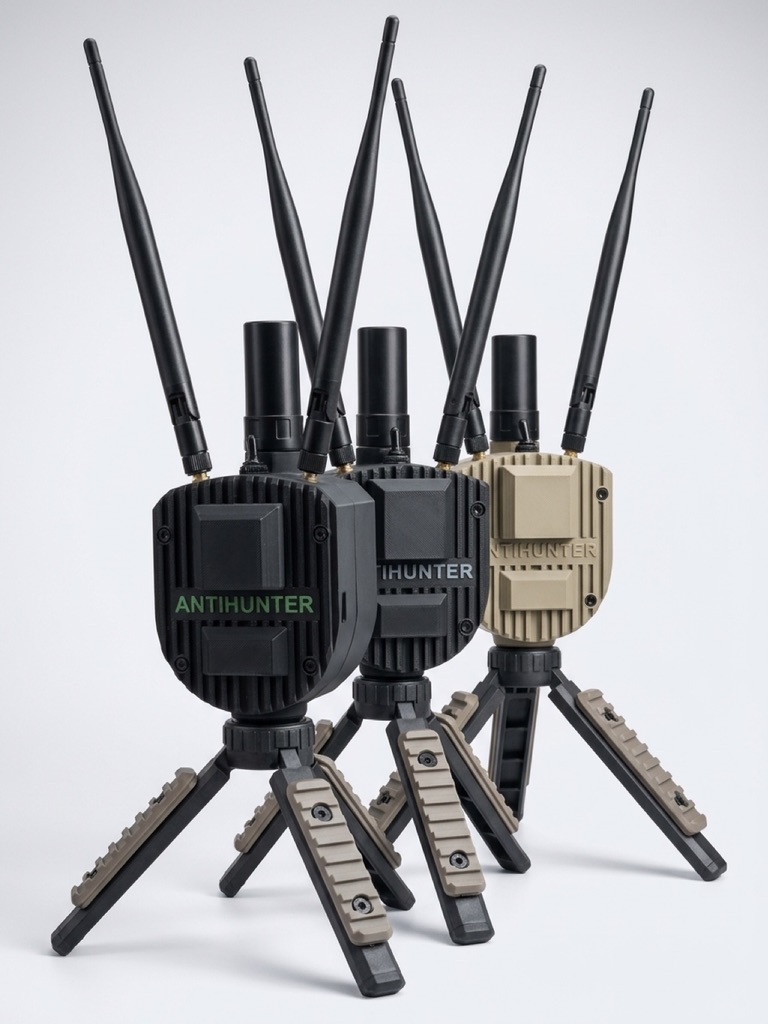
AntiHunter is distributed WiFi and BLE signal intelligence & attack detection. Controlled from its own WiFi, or using Meshtastic radio commands.
Vibration based scans and self-destruct option. Defensive by design. Knows the devices and networks around you, alerts when it matters. Integrates as far or close as you choose.
Swap the S3 for an ESP32-C5 and it scans 2.4 + 5 GHz WiFi 6 (beta)
No account, no subscription. Open source.
Featured in Seeed Studio's Best 20 XIAO Projects of 2025.
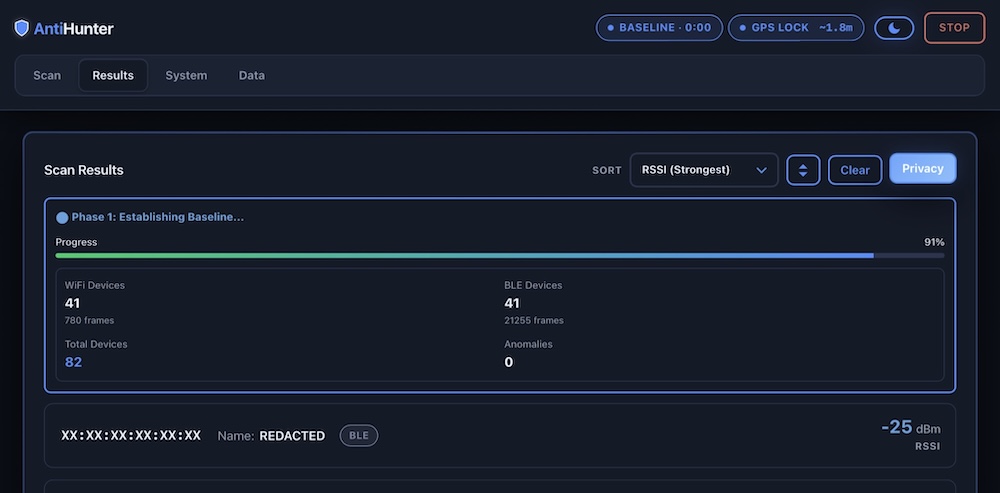
Cross-validation — On a mesh, nodes cross-check detections. Configurable threshold; outlier rejection at 5+ reports
WiFi motion sensing (beta) — The same CSI sensing ISPs sell as home motion but don't name. Reads how the room's WiFi bends around a moving body. Works in the dark, behind a closed door, in a room you've left. Listen-only, transmits nothing. No calibration, no baseline
Triangulation — 3+ GPS nodes locate a target on the map. Kalman-filtered, confidence-scored, Google Maps pin (experimental)
Vibration trigger — A bump starts a scan you choose, or wipes the SD and drops a decoy weather-station config
Privacy mode — One tap redacts MACs, GPS, and SSIDs before sharing a screenshot
Battery saver — 80 MHz CPU, light sleep, mesh heartbeat only
Allowlist — Global device allowlist, ignored across all scan modes
Self-recovery — Fixes a broken config on boot
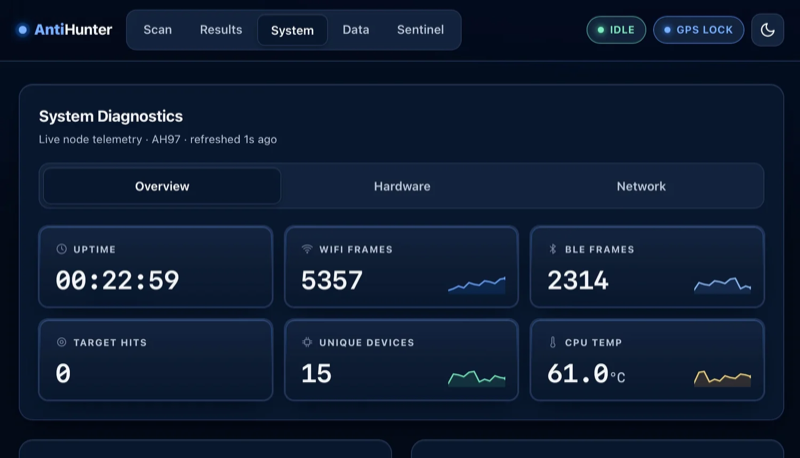
Pentesters — Passive recon of a target space. Every device, every probe, every network name
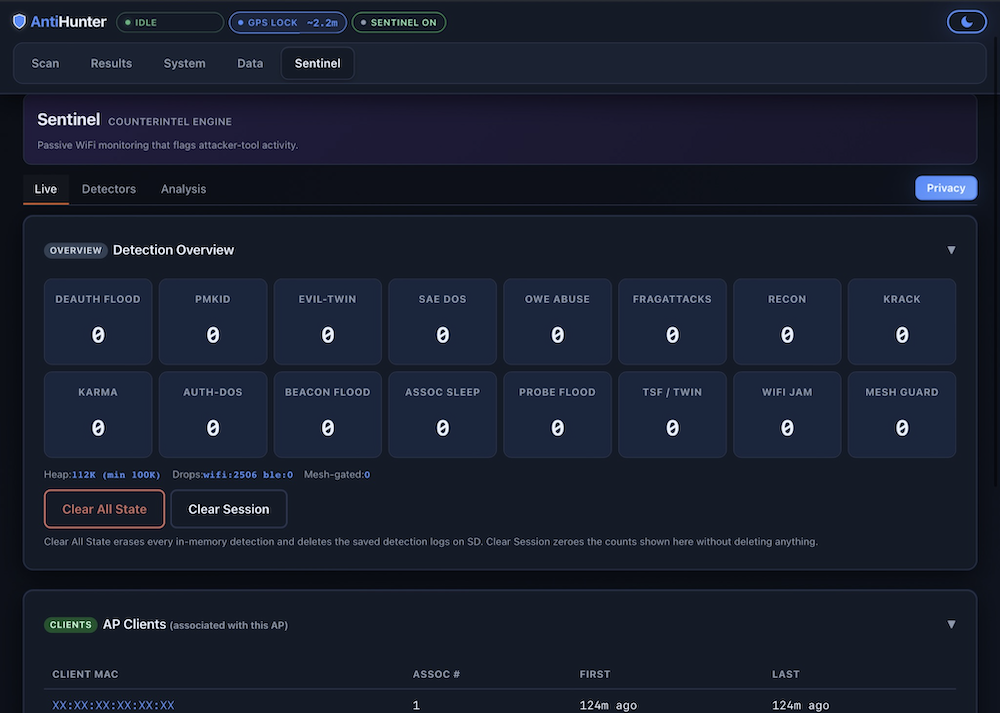
Blue teams — Continuous monitoring with tool-level attribution when someone attacks your network
Counter-UAS — Drone Remote ID collection with pilot position, fed to Command Center or TAK
Event security — Baseline a venue, get alerted on new or suspicious devices
OPSEC — Know what's around you. Vibration wipe. Decoy config. Headless mode
A Dedrone fixed site lists at $58,000. AntiHunter puts detection on a $250 node — battery-powered, LoRa meshed, no infrastructure, no fees.
| AntiHunter | Dedrone | Bastille | WiFi Pineapple | ESP32 Marauder | |
|---|---|---|---|---|---|
| Signals | WiFi, BLE, drone ID, attacks | Drone RF | WiFi, BLE, cellular | WiFi | WiFi, BLE |
| Names the attacker's tool | Yes | No | No | No | No |
| Battery / field deploy | Yes, 18650 or solar | No, mains | No, mains | No | Yes, handheld |
| Mesh, no infrastructure | LoRa, miles | No | No | No | No |
| Open source | Yes: firmware, STLs, C2 | No | No | Partial | Yes |
| Recurring fees | None | License | Subscription | None | None |
| Price | $180-350 | $58,000/site | Enterprise quote | ~$120–300 | Free–$170 |
(separate, free, open source)
The Command Center puts every node on one live map: drone tracks, geofence alarms, FAA lookup, ADS-B/ACARS, TAK bridge, MQTT federation, RBAC + 2FA, CSV/GeoJSON export. Self-hosted on your hardware.
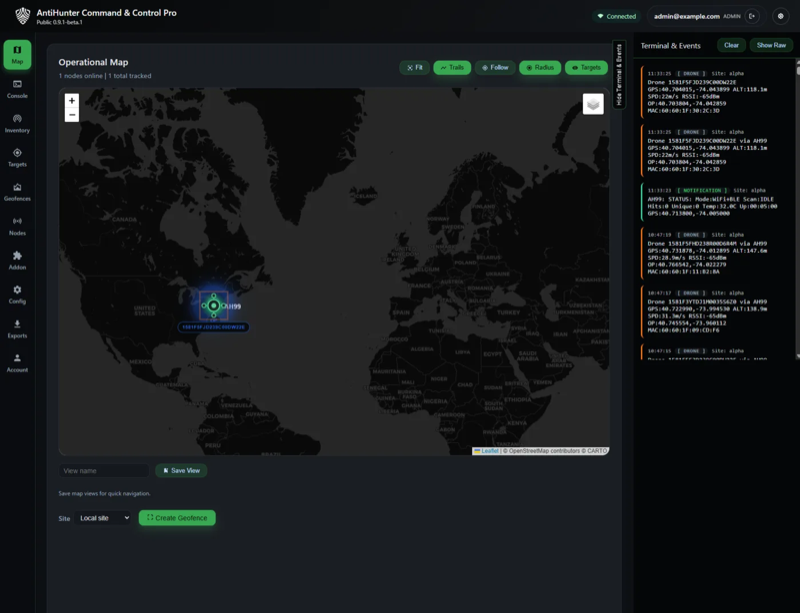
Run the PCB, build your own from parts or buy it assembled.
| 3: Soldered Core | 2: Parts Kit | 1: Fully Assembled | |
|---|---|---|---|
| Price | $180 | $250 | $350 |
| Ships | Core soldered, tested, no assembly required | Parts kit, build yourself | Built, tested, ready to deploy |
| You add | Power (USB) | Batteries, Active GPS SMA Antenna | Batteries |
A one-piece design which eliminates potential leaks from the bonding process. As a tradeoff, a minimal amount of support scaring can sometimes appear on the GPS antenna base:
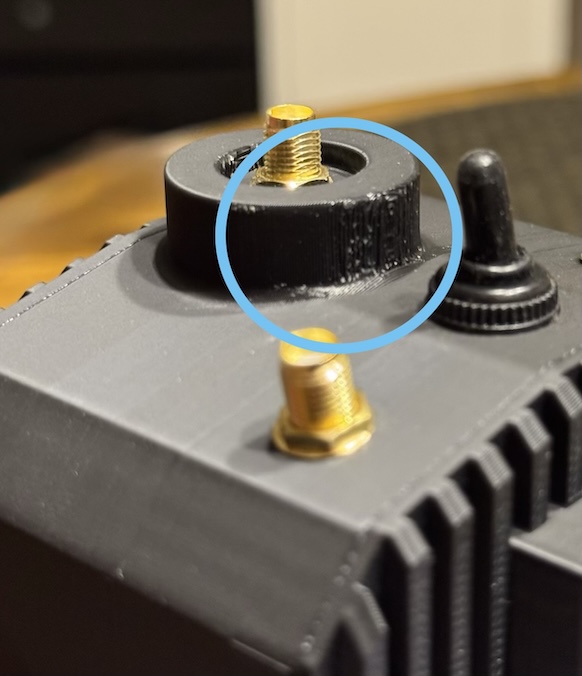
We do this to ensure no heat inset defects. Send a message before ordering to request a different case.
CORE COMPONENTS
CONNECTORS & FASTENERS
ANTENNAS & WIRING
POWER & THERMAL
ENCLOSURE
| RF | 2.4 GHz WiFi b/g/n + BLE. 2.4 + 5 GHz with ESP32-C5 |
| MCU | Seeed XIAO ESP32-S3 |
| Mesh | Heltec WiFi LoRa 32 V3.2, Meshtastic |
| GPS | ATGM336H + DS3231 RTC |
| Tamper | SW-420 vibration sensor |
| Storage | micro-SD, FAT32, 8/16 GB included |
| Power | USB-C / 18650 UPS / 5 V solar |
| Board | 82 mm circular, 2-layer, M3 + 1/4" tripod mount |
| Firmware | Open source (AGPL-3.0), browser flasher, stable + beta channels |
Note: Sentinel, WiFi motion sensing, and packet capture are beta. Perfect triangulation with this hardware is impossible, but still very accurate.
Detection only — it listens, it doesn't attack. Lawful use only. Disclaimer..
Runs AntiHunter firmware — patent pending, U.S. 64/151,838
• Dispatch is typically 1–3 business days when in stock. • Ships within the contiguous 48 US states via USPS Ground Advantage or Priority Mail • Every shipment includes a tracking number and $100 insurance via USPS • PCBs are bagged, sealed, and shipped in a bubble mailer. Orders of 6 or more ship boxed via USPS Priority Mail. • Parts kits are bagged, hex-paper padded and boxed. • Soldered units ship in ESD bags.
Note: Be sure to include your unit/apartment number if applicable. USPS returns packages if the address or name are not in their system.
In demand. 7 people bought this in the last 24 hours.
